
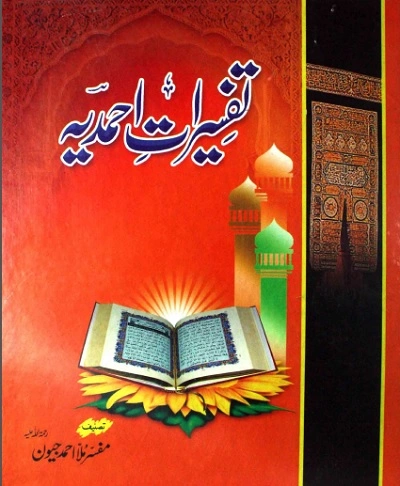
| Feature | Details |
| Book Name | Tafseerat e Ahmadiyya |
| Author Name | Mulla Ahmad Jeevan |
| Language | Arabic |
| Century | 17th Century |
| Subject | Quranic Legal Verses (Ahkam al-Quran) |
| Legal School | Hanafi Jurisprudence |
| Download Option | Available |
| Read Online | Available |
The study of Islamic jurisprudence and Quranic commentary has a rich history in the South Asian subcontinent. Among the most influential scholarly works from this region is Tafseerat e Ahmadiyya by Mulla Ahmad Jeevan. Written in Arabic during the seventeenth century, this unique text stands out because it focuses specifically on the verses of the Quran that contain legal rulings.
Instead of providing a general commentary on every verse, the author carefully separates and explains the command verses, making it a masterpiece for students and scholars of Islamic law. It serves as a vital bridge connecting divine revelation with the practical framework of the Hanafi school of thought.
About the Author
Mulla Ahmad Jeevan, whose full name was Sheikh Ahmad bin Abu Sa’eed, was a legendary Islamic scholar born in Amethi, India, during the Mughal era. He was a deeply respected figure who eventually became the tutor of the Mughal Emperor Aurangzeb Alamgir. Known for his profound intellect and sharp understanding of jurisprudence, Mulla Ahmad Jeevan contributed significantly to the academic landscape of his time. He was also one of the prominent scholars involved in compiling the famous legal code Fatawa Alamgiri. His dedication to teaching and writing left an enduring legacy in the fields of Islamic principles and legal theory.
Summary of Tafseerat e Ahmadiyya by Mulla Ahmad Jeevan
The book is structured beautifully as a thematic commentary that isolates the legislative verses of the Holy Quran. Tafseerat e Ahmadiyya by Mulla Ahmad Jeevan does not follow the traditional line-by-line format of a complete translation; rather, it categorizes verses related to human actions, worship, and social contracts. The author examines each legal verse by exploring its linguistic roots, historical context, and the reasons behind its revelation. By doing so, he simplifies how complex rules regarding daily life, family law, and community ethics are derived directly from the divine text.
Major Themes of the Book
Islamic Jurisprudence
The primary theme of Tafseerat e Ahmadiyya by Mulla Ahmad Jeevan revolves around the derivation of legal rules from the Quran. The text dives deeply into the methodology of extracting laws, ensuring that readers understand how divine commands translate into practical legal actions.
Support for the Hanafi School
A massive part of the text is dedicated to explaining and defending the positions of the Hanafi school of jurisprudence. The author uses strong logical and textual evidence from the Quranic verses to show why the Hanafi interpretations align seamlessly with the divine intent.
Clarity on Commanded Actions
The book highlights the distinction between different types of divine orders, such as what is strictly obligatory, what is recommended, and what is strictly forbidden. It provides an organized framework for understanding the boundaries of Islamic law.
Message & Moral Lessons
The central message of Tafseerat e Ahmadiyya by Mulla Ahmad Jeevan is that the Quran is not just a book of spiritual stories but a complete, living guide for running a just society. It teaches readers that laws must always be grounded in mercy, justice, and the well-being of the community. A major moral lesson from the work is the importance of academic honesty and intellectual rigor when interpreting sacred texts. The author shows that understanding religious law requires a balance of deep knowledge, open-minded logic, and profound respect for tradition.
Impact of Tafseerat e Ahmadiyya by Mulla Ahmad Jeevan
For centuries, this book has maintained a permanent place in the curriculum of traditional Islamic seminaries across South Asia, particularly within the Dars-e-Nizami system. Tafseerat e Ahmadiyya by Mulla Ahmad Jeevan bridged the gap between pure scriptural text and the complex world of legal theory. Generations of jurists, judges, and religious scholars have used it as a foundational manual to master the art of legal derivation. Its enduring popularity stands as a testament to its clarity and academic authority.
FAQs
What is the main focus of Tafseerat e Ahmadiyya by Mulla Ahmad Jeevan? The main focus of the book is to explain the legal and legislative verses of the Quran, specifically deriving rules according to the Hanafi school of Islamic law.
In which language was Tafseerat e Ahmadiyya by Mulla Ahmad Jeevan originally written? The book was originally written in Arabic, though it has been translated into Urdu and other languages for students worldwide.
Who was the author of Tafseerat e Ahmadiyya by Mulla Ahmad Jeevan? The author was Mulla Ahmad Jeevan, a celebrated seventeenth-century scholar from Amethi, India, who also tutored the Mughal Emperor Aurangzeb.
Why is Tafseerat e Ahmadiyya by Mulla Ahmad Jeevan taught in Islamic seminaries? It is taught because it offers an excellent, systematic approach to understanding how practical Islamic laws are extracted directly from the text of the Quran.
Conclusion
In conclusion, Tafseerat e Ahmadiyya by Mulla Ahmad Jeevan remains a timeless treasure in the realm of Islamic literature. By systematically analyzing the legal verses of the Quran, it provides invaluable clarity to anyone seeking to understand the foundations of Islamic jurisprudence. The brilliant scholarship of Mulla Ahmad Jeevan ensures that his work continues to guide students and scholars alike, preserving a vital legal heritage for generations to come.